Beijing 2022: The Mixed Reality Pavilion
A systematic approach to interactive exhibition design
OVERVIEW
This project was part of a collaboration to design an immersive interactive experience for 2022 Beijing Winter Olympic Games Alibaba Exhibition.
The goal was to create an immersive environment that combined digital interaction, physical space, and storytelling to celebrate winter sports and innovation.
We developed a fully realized digital-physical interaction framework designed for a 5,000+ sq. ft. pavilion. The system reached the final implementation stage, showcasing a high-fidelity convergence of spatial logic and user-centric storytelling.
Due to the pandemic, the project was later transformed into a fully online experience. While the on-site installation was never realized, the design exploration provided valuable insights into spatial interaction and adaptive digital storytelling.
MY ROLE
Lead Experience Designer via InsPUMP
RESPONSIBILITIES
-
Orchestrating the end-to-end visitor journey and multi-modal interaction flows within the physical exhibition space.
-
Developing service blueprints, spatial journey maps, and digital touchpoint architectures.
-
Collaborating with 3D environment designers and content teams to align physical and digital storytelling
STATUS
Implementation-Phase Project (NDA Protected)
Design Challenges
How might we merge storytelling and interaction within limited space?
Spatial Conflict
Resolving the tension between lingering narrative engagement and the need for efficient visitor circulation.
Cognitive Consistency
Defining a unified interaction language across disparate hardware and software mediums (MR, LiDAR, Touch).
Safety & Accessibility
Implementing universal design principles within a high-tech, dynamic physical environment.
Design Research
We Knew It's Always Chaos
Crowd Dynamics: Analysis of spatial movement patterns in large-scale pavilions to prevent flow stagnation.
Interaction Benchmarking: Comparative study on gesture-based vs. touch-based modalities in high-traffic, multi-sensory environments.
Ecosystem Mapping: Identifying key data touchpoints within the Alibaba infrastructure to be translated into immersive visual narratives.
Designing for Diverse Engagement:
Visitor Archetypes

A: The Efficiency Skimmer
Focus: High Impact & Immediate Value
Behavioral Profile: Driven by time efficiency and high-level visual impact. These visitors seek the "highlight reel" of the exhibition and have a low threshold for dense information or long wait times.

B: The Immersive Explorer
Focus: Narrative Depth & Technical Nuance
Behavioral Profile: Detailed-oriented visitors with a strong interest in the technical back-end and the Olympic narrative. They are willing to invest significant dwell time in exchange for depth and complexity.

C: The Digital Amplifier
Focus: Shareability & Social Currency
Behavioral Profile: Aesthetically driven users who view the physical space as a canvas for social storytelling. Their primary goal is to capture and broadcast unique "phygital" moments to their digital networks.
UX Design Response A:
-
Glanceable Hierarchy: Implementing a flattened information architecture for 3-second comprehension.
-
Passive Interaction: Triggering environmental sensors and large-scale projections that respond to presence without requiring active input.
-
Spatial Speed-lanes: Defining clear, unobstructed circulation paths for a seamless "fast-track" experience.
UX Design Response B:
-
Layered Information: Designing secondary and tertiary content layers within the MR experience for deeper data exploration.
-
Skill-Based Feedback: Developing interaction loops that reward precision—such as force-feedback in curling simulations—to increase engagement satisfaction.
-
Dedicated Dwell Zones: Creating semi-enclosed "islands of immersion" to protect focus from external crowd noise and traffic.
UX Design Response C:
-
Optimum Capture Points: Strategically placing "hero-shot" anchors with curated lighting to ensure high-quality, brand-consistent photography.
-
Frictionless Mementos: Generating personalized digital assets (e.g., customized athletic performance posters) instantly accessible via QR codes.
-
Cohesive Brand Logic: Ensuring every digital-physical touchpoint aligns with the core Visual Identity System (VIS) to maintain brand recognition across social platforms.
Spatial Analysis:
Visualizing Crowd Dynamics
To ensure a seamless 5,000+ sq. ft. journey, I conducted a spatial flow analysis to identify potential bottlenecks and interaction friction.
-
Congestion Management: Red zones indicate high-pressure areas (Entrances/Core AR games). I implemented serpentine queue systems (dashed lines) to maintain a steady flow.
-
Interaction Buffering: High-engagement blue zones were strategically placed outside the primary circulation path, creating "islands of immersion" that balance individual experience with overall throughput.


Optimized Routing Strategy
Bridging the Phygital Gap:
Environmental Research
Visual Integrity & Lighting Logic
The Situation: The pavilion’s high-contrast lighting—combining dim ambient areas for MR immersion with intense spotlights for physical exhibits—threatens the visibility of digital interfaces and user focus.
Strategic Response: We developed a Lighting-Adaptive Visual Hierarchy. By utilizing high-contrast UI elements and intentional "glow" effects on interactive borders, we ensured that the digital narrative remains legible and immersive, regardless of localized lighting interference.
Auditory Clarity & Feedback Loops
The Situation: With peak-hour noise levels often masking standard UI sound effects, visitors may lack the necessary "confirmation" of their actions, leading to confusion and repetitive, frustrated interactions.
Strategic Response: We implemented Multi-modal Feedback Synchronization. To ensure every gesture or touch is acknowledged, we reinforced auditory cues with immediate, synchronized visual pulses. This allows visitors to "see" their impact on the narrative even when they cannot clearly "hear" it.
Spatial Throughput & Passive Wayfinding
The Situation: High visitor density can obscure floor-level signage and traditional wayfinding, creating bottlenecks and disrupting the "simple to navigate" objective.
Strategic Response: Based on our Heatmap Analysis, we prioritized Passive Wayfinding. By using ceiling-integrated lighting paths and spatial digital cues, we guided the visitor flow intuitively from the entrance to core interactive zones, minimizing cognitive load during transit.
Hierarchical Interaction Mapping
The Situation: Transitioning visitors from passive discovery in the main halls to high-intensity engagement in the sports zones without cognitive friction.
Strategic Response: We utilized Motion Capture to trigger reactive animations, allowing for zero-friction, "touchless" immersion in the hall. We also designed Physical Device Simulations for the 4 core sports, providing high-fidelity tactile feedback for an earned, athletic experience.
Interaction Modality Benchmarking:
A Multidimensional Analysis
To optimize the balance between grand-scale narrative and personal athletic immersion, we analyzed our two primary interaction modalities across six key performance indicators. This data-driven approach allowed us to assign the right technology to the right spatial zone.
-
The "Ambient" Logic (Motion Capture): Optimized for high throughput and spatial efficiency, ensuring that the Main Hall functions as a low-friction, collective entry point into the Olympic spirit.
-
The "Focused" Logic (Physical Devices): Prioritized kinesthetic engagement and sensory immersion, creating the "Hero Moments" of the pavilion through high-fidelity sports simulation.
Curling Simulation

Speed Skating Simulation

AR Snowball Fight

Virtual Avatar Stage

Bobsleigh MR Experience

Interactive Screen

concepts
The Experience Ecosystem:
From Ambient Narrative to Athletic Simulation
This pavilion was designed as a multi-layered ecosystem, transitioning visitors from a "low-friction" discovery phase into "high-intensity" sports simulations. By blending touchless motion-capture environments with specialized physical hardware, we created a comprehensive journey that translates Alibaba’s technological prowess into a tangible Olympic experience.
PART I: AMBIENT & TOUCHLESS INTERACTIONS
Focus: Cultural Storytelling and Intuitive Engagement
01. The Cultural Corridor: Legacy & Innovation
A curated walkthrough chronicling Alibaba’s evolution within the Olympic movement. This installation serves as a digital archive, utilizing large-scale synchronized displays to showcase technological milestones and the integration of Alibaba’s ecosystem into global infrastructure. It transforms corporate data into a compelling visual narrative of progress and digital transformation.
02. Interactive Horizons: The AR Gate & Circular Canvas
Positioned at the pavilion’s core, these installations redefine spatial awareness.
-
The AR Gate: A motion-capture mirror that transports visitors into a high-fidelity winter landscape. Users interact with reactive animations and record personalized AR "souvenirs," blending the physical self with the digital environment.
-
The Circular Canvas: A responsive lighting ecosystem that reacts to crowd density and flow. It generates real-time silhouettes and ambient "ice-textured" visuals, turning visitor movement into a collective piece of generative art.
03. Bingbing’s Digital Stage: The Virtual Avatar DJ & Hub
Featuring "Bingbing," the pavilion’s AI avatar, this stage serves as the heart of information and atmosphere.
-
DJ & Atmosphere: Bingbing maintains the pavilion’s energy through curated music and real-time social gestures.
-
Educational Sprints: On the hour, the stage shifts into an educational hub, where Bingbing utilizes data visualization to explain Olympic rules, equipment history, and medal statistics, bridging the gap between entertainment and professional sports knowledge.
PART II: CORE ATHLETIC SIMULATIONS
Focus: Physical Precision and High-Fidelity Engagement
04. Precision Curling: A Hybrid Sensor Framework
Due to spatial constraints, we re-engineered the curling experience into a hybrid digital-physical setup.
-
The Mechanism: A two-part floor system consisting of a high-precision sensor track and a digital rendering lane. Visitors launch physical stones integrated with force-sensors, while the physics engine translates real-world momentum into a precise digital trajectory.
-
Cross-Platform Engagement: To manage queue times, we launched a companion Alipay Mini-App, allowing visitors to engage in a simplified version of the game via mobile while waiting for the physical experience.

05. AR Frost Battle: Competitive Spatial Engagement
A high-stakes 3v3 team experience that utilizes AR glasses and specialized sensor gloves.
-
Game Logic: The court is divided into zones where gesture-recognition logic defines the combat: palm-outward for "Shield" and throwing motions for "Snowballs."
-
System: With a strategic health/shield point system, this project showcases the potential of low-latency spatial computing in a competitive group setting.

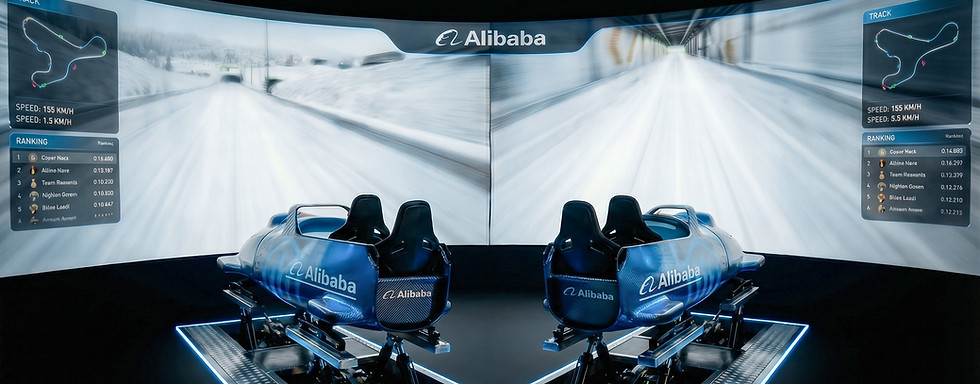
06. Kinetic Descent: The Bobsleigh MR Experience
A multi-sensory simulation that mirrors the intensity of a professional flight simulator.
-
The Setup: A massive curved screen paired with a dual-seater motion platform.
-
The Simulation: The platform tilts and vibrates based on track geometry (turns, inclines, and speed), while an integrated physics engine calculates velocity based on the passengers’ physical shifts. It provides a visceral sense of G-force and speed through synchronized visual-kinetic feedback.

07. Velocity Gait: Professional Speed Skating Simulator
A collaboration with third-party professional hardware to bring elite training techniques to the public.
-
The Hardware: Participants use specialized skating shoes on a fixed-track sensor rail.
-
The Logic: The system analyzes the user’s gait and stroke frequency in real-time, providing an accurate representation of their potential speed. It’s an "edutainment" masterpiece that allows laypeople to master professional athletic movements through data-driven guidance.

FINAL REFLECTION
Designing for Uncertainty:
Synthesis & Growth
Lead designing the Alibaba Winter Olympic Pavilion was an exercise in managing unprecedented complexity. It required balancing large-scale spatial dynamics, multi-modal hardware integration, and the high-stakes brand narrative of a global technology leader.
Key Takeaways & Leadership Insights
-
From Interface to Environment: This project redefined my understanding of "User Experience." I moved beyond the screen to orchestrate a 5,000 sq. ft. ecosystem, where the "UI" is the physical floor, the user's gait, and the ambient lighting. Learning to design for Proprioception (body awareness) was as critical as designing for visual clarity.
-
The "Zero-Friction" Imperative: In high-traffic Olympic environments, simplicity is a technical achievement. By implementing Passive Navigation and Touchless MoCap, I learned that the most powerful interactions are often the ones the user doesn't have to "learn"—they simply happen as a result of their natural presence.
-
Resilience & Strategic Readiness: While macro-environmental shifts ultimately pivoted the project's implementation phase, the resulting "Ready-to-Deploy" framework stands as a benchmark for Alibaba’s future MR explorations. It proved that a robust design system must be both visionary in its tech and pragmatic in its spatial logic.
Final Thought
"Technology is most magical when it recedes into the background, leaving only the thrill of the sport and the clarity of the narrative."